
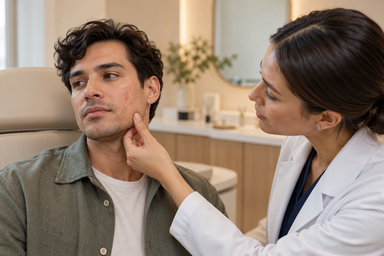
Harmony ClearSkin may form part of a clinician-led plan for selected acne concerns, but it is not a guaranteed cure or a replacement for diagnosing the acne correctly. There is no universal session count that reliably clears every person’s skin. The right plan depends on lesion type, severity, skin tone and other treatments. [1] [2]
What is ClearSkin?
ClearSkin is a non-ablative Er:Glass laser applicator associated with Alma’s Harmony platform. The technology uses 1540 nm energy with cooling; exact features depend on the applicator version. It should not be confused with an ablative resurfacing treatment or assumed to treat every type of acne equally. [1]
Before booking, ask whether the proposed treatment is directed at active spots, residual marks or scars. These are distinct problems. A package labelled “acne laser” can be difficult to evaluate unless its aim is clear.
Where does laser fit in an acne plan?
The American Academy of Dermatology notes that light and laser treatments may help selected patients, often alongside other treatment. Its acne guideline also identifies insufficient evidence to make recommendations for many procedural approaches. That is a reason for measured expectations, not a promise that laser is the next step for everyone. [2] [3]
Deep nodules, scarring acne or a pattern needing medical treatment should not be left uncontrolled while a cosmetic course is repeated. Ask how the proposed laser fits with established options and what happens if new inflammatory lesions continue.
How many sessions will you need?
A series may be proposed, but the number should follow an assessment and review plan. Request an initial estimate, the spacing and the criteria for continuing. “Six sessions” means little unless the clinician explains why that schedule fits your case.
Agree on what will be measured: fewer new lesions, less inflammation or improved texture. Use consistent photographs and avoid treating early redness as evidence that the treatment is working. Further sessions should be justified by response, not merely by the original package.
Recovery and safety
Temporary redness, swelling or discomfort may occur. Burns, pigment changes and scarring are possible with laser treatments. Tell the clinician about recent tanning, medication, active infection and your tendency to develop dark marks. Follow the prescribed skincare and sun-protection plan. [2]
Questions worth asking
Which applicator will be used? Why is it appropriate for my acne type? Will I still need medication? When will we reassess, and what would make us stop?
First establish what is being treated
Active acne, the dark marks left after spots and indented acne scars are separate treatment targets. They may occur together, but improvement in one does not prove that the others have been treated. Before discussing ClearSkin, identify which problem matters most and whether new inflammatory lesions are still appearing. A useful assessment includes lesion type, severity, location, previous treatment and any developing scars. [2] [3]
This prevents a common mismatch: booking a laser package for acne when the main concern is actually pigmentation or established scarring. It also helps explain why a dermatologist may recommend medical treatment before a procedure. The priority may be preventing new damage rather than resurfacing skin that is still actively inflamed.
What the ClearSkin name tells you
ClearSkin is an applicator within the Alma Harmony family. The manufacturer’s brochure describes a non-ablative 1540 nm Er:Glass approach with cooling and vacuum-assisted technology. These specifications describe how the system delivers treatment; they do not establish that every clinic uses the same protocol or that the device will outperform medicines for your acne. [1]
Ask which Harmony platform and ClearSkin applicator are being used, who performs the procedure and who sets the clinical plan. Product generations and treatment settings can differ. A brochure’s general description cannot tell you the number of sessions, energy settings or likely recovery appropriate for your skin. Those decisions require an individual assessment.
How laser fits alongside established acne care
Acne care may include topical medicines, oral medicines, hormonal treatment for selected patients and adjustments to an irritating routine. The AAD’s 2024 guideline supports several established medical treatments and notes insufficient evidence to make broad recommendations for certain procedures, including laser and light approaches. That does not mean every procedure is ineffective; it means confidence in a universal recommendation is limited. [3]
A sensible discussion therefore asks what laser is expected to add to your existing plan. Is the aim to address persistent inflammatory lesions, improve tolerability when another option is unsuitable, or complement ongoing treatment? The answer should be specific. “It treats acne” is less useful than a plan that identifies the target, alternatives and criteria for reviewing benefit.
Why there is no single correct session count
A treatment series may be proposed, but the number should be connected to response and a review schedule. Acne severity, skin type, treatment settings, concurrent medicines and the distinction between active lesions and residual marks all affect planning. The AAD explains that laser and light treatment often requires a series and that results vary. [2]
Before buying a package, ask when the clinician will reassess progress. A useful agreement describes what happens if acne worsens, if the skin becomes irritated or if there is little meaningful improvement. More sessions should not become the automatic answer to every disappointing result. The diagnosis and overall management plan may need reconsideration.
Questions to ask before committing to a series
Ask whether your acne is predominantly comedonal, inflammatory or nodular, and how that affects the recommendation. Ask whether the procedure is intended to replace a medicine or work alongside it. Confirm which products you should continue, pause or restart, with instructions from the treating clinician rather than assumptions based on another person’s experience.
Also ask about the total expected cost, review appointments, photographs, aftercare and management of complications. Find out whether the price includes only treatment sessions or also the medical assessment. A clearly explained plan makes it easier to compare clinics on clinical suitability and follow-up rather than on the advertised number of sessions alone.
What a baseline assessment should capture
Baseline photographs are most useful when lighting, camera angle and distance remain consistent. Record the areas affected and the type of lesions, rather than relying only on a general impression that skin looks clearer. A reduction in painful inflammatory spots may be meaningful even if old marks remain visible, while a brighter photograph may exaggerate apparent improvement.
Include your experience as well as images. Pain, frequency of new lesions, irritation and how manageable the routine feels are relevant. Share previous treatments honestly, including those stopped early. The aim is not to judge adherence but to understand whether a treatment failed, was poorly tolerated or was never used long enough to assess.
Preparing your skin without overcomplicating it
Preparation should follow the clinic’s instructions for the exact treatment. Disclose recent tanning, sun exposure, other procedures, medicines and any current rash or skin infection. Bring a list of active skincare ingredients. Do not independently stop prescribed treatment simply because a social media post suggests all acne medicines are incompatible with lasers.
Avoid arriving with newly irritated skin from an aggressive peel or unfamiliar home treatment. If your skin is burning, cracked or unusually sensitive, contact the clinic before the session. An assessment may lead to rescheduling or adjusting the plan. A delayed procedure can be more sensible than treating skin that is not ready.
What treatment may feel like
Sensation and immediate skin response vary with the protocol and the individual. Cooling is part of the device design, but that does not make discomfort or adverse effects impossible. Ask what sensations are expected, how the practitioner monitors your skin and how you can signal that something feels wrong. [1] [2]
Do not interpret severe discomfort as proof that treatment is working better. The operator should respond to your feedback and visible skin changes. After the session, ask which reactions are expected and for how long, together with a contact route if symptoms are stronger or more persistent than the instructions describe.
Aftercare should support the treatment plan
A gentle routine and appropriate sun protection may be part of aftercare, but the precise instructions should come from the treating clinician. Ask when to restart active products, whether makeup is appropriate and what to do if the skin feels irritated. Avoid adding new exfoliants in an attempt to accelerate improvement.
Continue the agreed acne plan unless instructed otherwise. A procedure does not automatically remove the need for maintenance treatment. If a medicine has been paused, make sure the restart instructions are clear. Unplanned gaps, frequent product changes and extra treatments can make it difficult to distinguish a laser response from changes in the rest of the routine.
Skin tone and pigment history matter
Tell the clinician if previous spots, burns or procedures have left dark or light patches. This history helps inform risk assessment. Laser and light procedures can cause unwanted pigment changes, and suitable settings and careful patient selection matter. A general claim that a device is appropriate for many skin types is not a guarantee for every individual. [2]
Discuss recent tanning separately from your natural skin tone. Ask whether a test area is appropriate and how the clinic evaluates your response. Sun protection is part of the broader plan, particularly when residual pigmentation is a concern. A treatment that reduces some lesions but causes troublesome marks may not meet your overall goals.
When medical treatment should take priority
Deep painful nodules, rapidly developing scars or significant distress deserve prompt dermatology assessment. A cosmetic package should not delay consideration of established treatment options. The clinician may recommend a different approach, or a combination in which laser has a limited supporting role. [3]
Similarly, acne-like bumps that are unusually itchy, uniform or linked to shaving may need diagnostic review. Not every facial bump is acne. If the diagnosis is uncertain, treating the skin repeatedly with a device can postpone appropriate care. Ask what findings support the diagnosis and what would prompt the clinician to reconsider it.
How to judge whether a course is worthwhile
Agree on a review point and compare like with like. Look at new lesion frequency, the severity of flares and tolerability, alongside consistent photographs. Separate active acne from old marks and scars. A single good week or a photograph taken immediately after a facial is not a reliable measure of sustained control.
Discuss whether any benefit continues between sessions and how maintenance will work. If the outcome is modest, weigh it against cost, inconvenience and adverse effects. A useful review can lead to continuing, modifying or stopping treatment. There is no obligation to continue a procedure simply because the original package included more appointments.
Ask what maintenance would involve
Before starting, clarify whether the clinic expects occasional review, continued medicines or further procedures after the initial course. Maintenance should be based on your response and ongoing acne activity. It should not be assumed that every improvement requires an indefinite series of laser appointments.
Frequently asked questions about ClearSkin
Can ClearSkin permanently cure acne?
No procedure can promise that acne will never recur. Acne can fluctuate over time and may require maintenance. Laser and light results vary, and some people need additional treatment. The practical goal is an improvement that is meaningful, tolerable and sustainable within an overall acne plan. [2]
Will it remove acne scars at the same time?
Do not assume that a treatment chosen for active acne will adequately address established scars. Scar type and depth require separate assessment. Ask the clinician to distinguish the immediate acne-control goal from any later scar plan, including whether inflammation should be controlled first.
Can I combine it with prescription skincare?
Possibly, but the combination and timing need individual instructions. Give the clinician the exact product names and strengths. Ask what to continue and what to pause, and obtain restart advice. Do not make independent changes to a prescribed regimen simply to fit a laser appointment.
Is a larger package always better value?
Only if the treatment is appropriate and the proposed course remains justified. Compare the assessment, review process and aftercare as well as price. A smaller initial commitment with a clear reassessment point may provide more useful information than a long course with no defined measure of success.
What should I bring to consultation?
Bring your skincare and medicine list, previous treatment history, photographs of significant flares and a clear description of your main concern. Mention scarring, pigment changes and any upcoming travel. These details help the dermatologist assess whether ClearSkin is a reasonable option and how it would fit into your wider care.
Your decision checklist
- Confirm active acne rather than marks or scars as the target.
- Ask what ClearSkin adds to established medical treatment.
- Agree on a review point before committing to repeated sessions.
- Assess new lesions and tolerability with consistent photographs.
Discuss your next step with Reformery
Contact Reformery to confirm device availability and arrange medical dermatology assessment before committing to a course.
Related reading
- Adult Acne or Rosacea? Why the Right Diagnosis Changes Your Treatment Plan
- Best Acne-Scar Treatments in Dubai: Laser, Subcision or Microneedling?
- Hormonal Acne Along the Jawline: Causes and When to See a Dermatologist
Medical disclaimer
General information only. Individual assessment and clinician-led aftercare are essential. This article does not replace an examination, diagnosis or personalised medical advice. The featured image is an AI-generated illustration, not a real patient, staff member or treatment result.
