
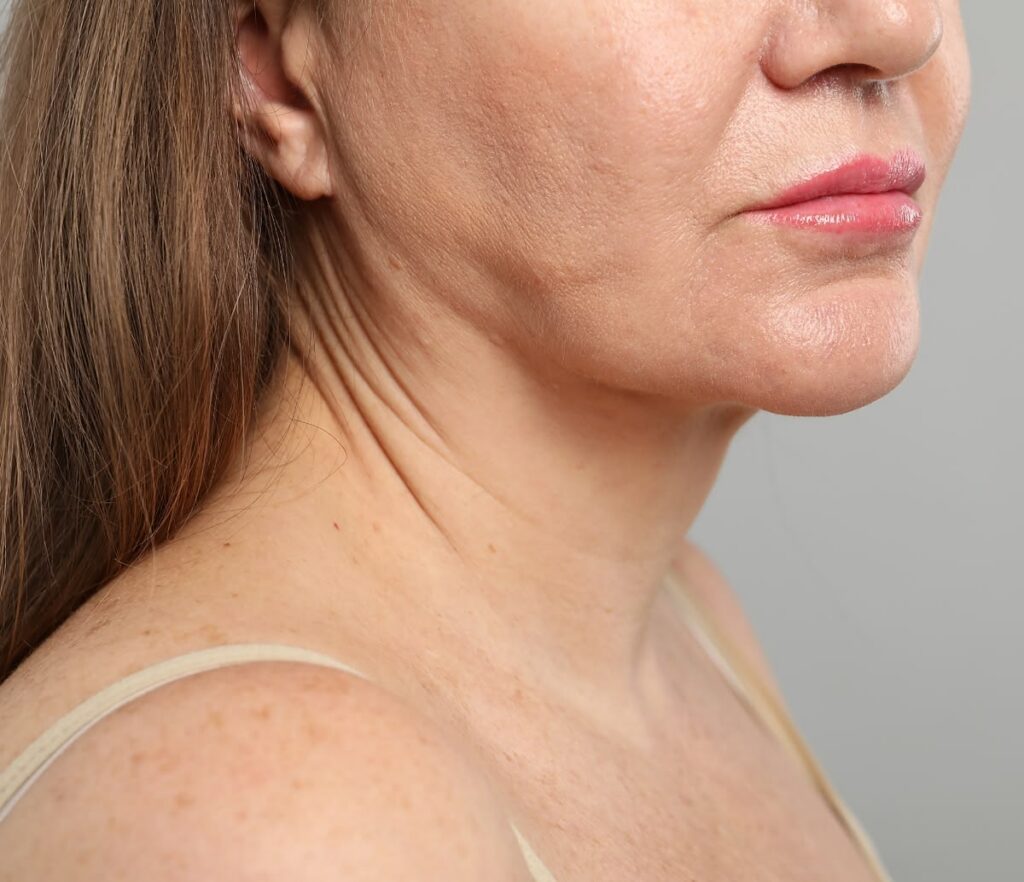
You may be pleased with what weight loss has done for your health, yet surprised by flatter cheeks, hollow temples or a less defined jawline. Online, these changes are often called “Mounjaro face”.
Treatment depends on what changed. Dermal filler may restore selected support; a collagen-stimulating injectable can build gradual structure; Morpheus8 or Forma may address mild laxity; and skin boosters focus on hydration and texture. A measured combination may suit more than one concern.
“Mounjaro face” is not a medical diagnosis or a formally recognised condition. It is a colloquial term for facial changes noticed after significant weight loss. The same changes can follow weight loss achieved through other medication, bariatric surgery, diet or lifestyle changes. They do not mean that Mounjaro has damaged the face.
What causes “Mounjaro face”?
Facial fat helps shape the cheeks, temples and area beneath the eyes. When body weight falls, facial fat may reduce too. If the change is substantial or faster than the skin can adapt, the result can be:
- flatter cheeks or temples;
- more visible under-eye hollows;
- deeper-looking folds around the mouth;
- looser skin along the lower face or neck; and
- fine lines that appear more noticeable.
A 2024 systematic review linked major weight loss with mid-cheek volume reduction and central neck laxity, although research specific to medication-assisted weight loss remains limited. Age, genetics, sun exposure, smoking, the pace of weight loss and baseline skin elasticity all influence the outcome.
A person with volume loss needs a different plan from someone concerned mainly by laxity or texture. A responsible consultation begins with the face, not a treatment menu.
When is the right time to consider treatment?
There is no universal waiting period. Assessment often makes more sense once weight is approaching a stable point, as facial contours may continue to change during rapid loss.
Stability does not mean stopping a prescribed medicine. Do not pause, reduce or discontinue Mounjaro for cosmetic reasons without speaking to the clinician who prescribed it. If weight loss is unexpectedly rapid, or if you feel weak, unwell or unable to eat adequately, seek medical advice before arranging an aesthetic procedure.
Your practitioner should review your health, medicines, previous procedures and weight trajectory, then examine facial movement, skin thickness and the pattern of volume loss. Sometimes the appropriate first step is simply time, nutrition within your medical plan and sun protection.
Which treatments may help after weight loss?
1. Dermal fillers for targeted volume support
Hyaluronic acid dermal fillers may be considered when facial volume loss after weight loss creates hollowing or unbalanced contours. A conservative plan may focus on strategic support in the cheeks or temples, depending on anatomy and product suitability.
The volumising effect appears relatively quickly. However, filler does not tighten significant loose skin, and more is not necessarily better. The aim is proportion and support, not replacing every millilitre lost on the scale.
Possible effects include swelling, tenderness, redness, bruising, infection, lumps or delayed inflammation. The FDA notes that accidental injection into a blood vessel is rare but can cause tissue damage, vision loss or stroke. Product choice, anatomy knowledge and informed consent are therefore essential for anyone considering dermal fillers in Dubai.
2. Sculptra for gradual collagen support
Sculptra contains poly-L-lactic acid and stimulates collagen rather than providing filler’s immediate gel-like correction. It may suit selected patients seeking gradual change for broader deflation or reduced firmness.
Results develop over weeks to months, and a course may be advised. Sculptra is not appropriate for every area or patient, and it cannot match filler’s precision for a small contour. Swelling, bruising, papules, nodules, infection and other complications are possible.
For someone comparing a collagen-stimulating treatment in Dubai with filler, the practical difference is timing and purpose: filler provides targeted volume; Sculptra encourages a slower biological response. In some plans the two are complementary, but they should not be treated as interchangeable.
3. Morpheus8 for laxity and texture
Morpheus8 combines microneedling with radiofrequency at controlled depths. It may be considered for mild laxity with uneven texture, enlarged pores, acne scarring or fine lines.
Improvement develops gradually. Redness, swelling, pinpoint marks and sensitivity may follow; burns, pigment change, infection or scarring are less common but possible. Settings and depth must be individualised, especially for a lean face. Morpheus8 can support firmness and texture, but it does not replace volume.
4. Forma RF for gentle firming
Forma radiofrequency uses controlled heating without needles. It may appeal to someone seeking gradual skin tightening after weight loss with little interruption to their routine. The treatment is generally discussed for early laxity and maintenance rather than marked skin excess.
Temporary warmth, redness or sensitivity may occur. A course is often needed. If the cheeks are hollow as well as lax, Forma alone is unlikely to recreate lost structure; a staged plan may address volume and skin separately.
5. Skin boosters for hydration and skin quality
Skin boosters primarily target hydration, elasticity and texture. They may soften dehydration lines but do not substitute for structural filler or lifting.
Small bumps, redness, swelling, tenderness and bruising can follow, while infection and other injectable complications are possible. Skin boosters make sense when the concern is skin quality—not simply lost volume.
6. Thread lifting for selected cases
For mild to moderate laxity, thread lifting may be discussed. Dissolvable threads can support selected areas but cannot remove substantial loose skin or restore widespread volume.
Risks include bruising, swelling, tenderness, dimpling, asymmetry, infection, visible or palpable threads and possible correction. A consultation should compare threads with injectables, energy-based treatment or a surgical opinion.
How the options compare
| Main concern | Option that may be discussed | What it is designed to do | Key limitation |
|---|---|---|---|
| Localised hollowing or reduced support | Dermal filler | Restore selected volume and contour | Does not remove loose skin |
| Diffuse deflation and reduced firmness | Sculptra | Encourage gradual collagen formation | Results are not immediate |
| Mild laxity plus texture concerns | Morpheus8 | Remodel skin with RF microneedling | Does not replace lost fat |
| Early laxity with low downtime priority | Forma RF | Support gradual firming | Subtle; usually requires a course |
| Dehydration and fine texture | Skin boosters | Improve hydration and skin quality | Not a volumising or lifting treatment |
| Selected tissue descent | Thread lift | Provide mechanical support | Not suitable for marked excess skin |
Why combination treatment may be more natural
Post-weight-loss change rarely occurs in one layer. One person may have cheek deflation, lower-face laxity and dehydrated skin together. Correcting all three with filler can create heaviness without improving the skin; a tightening device cannot rebuild a hollow temple.
A staged plan may use a small amount of filler for structure, collagen support for firmness and skin treatment where it adds value. It also shows how the face responds before more is recommended. Procedures placed too close together can increase irritation and complicate healing.
Frequently asked questions
Is “Mounjaro face” permanent?
Not necessarily. The face may settle as weight stabilises, but lost fat and established laxity do not always return. Assessment can separate temporary change from a treatable concern.
Should I stop Mounjaro before aesthetic treatment?
Do not change prescribed medicine without guidance. Tell your prescriber and aesthetic practitioner about planned procedures, as instructions differ by health status, procedure and use of sedation.
What is the best treatment for “Mounjaro face”?
There is no single best treatment. Filler addresses selected volume loss; Sculptra offers gradual collagen stimulation; Morpheus8 and Forma target different degrees of laxity; skin boosters focus on hydration and texture. Significant loose skin may require a surgical opinion rather than repeated non-surgical treatment.
Can treatment be done while I am still losing weight?
Sometimes, but ongoing change makes the endpoint less predictable. Your practitioner may advise waiting, conservative treatment or staged reviews.
A measured next step at The Reformery
The goal of Mounjaro face treatment in Dubai should not be to erase evidence of weight loss or make every face look the same. It should be to understand the specific anatomical changes, discuss realistic options and decide whether treatment is worthwhile for you.
At The Reformery, a consultation can assess volume, laxity and skin quality separately before any plan is proposed. Results and recovery vary between people, and no aesthetic procedure is risk-free. If you are concerned about changes after weight loss, book a consultation for individual medical advice, expected benefits, alternatives, costs and potential complications.
This article is for general education and does not replace a medical consultation. Treatment suitability can only be confirmed after an assessment by an appropriately licensed healthcare professional.
